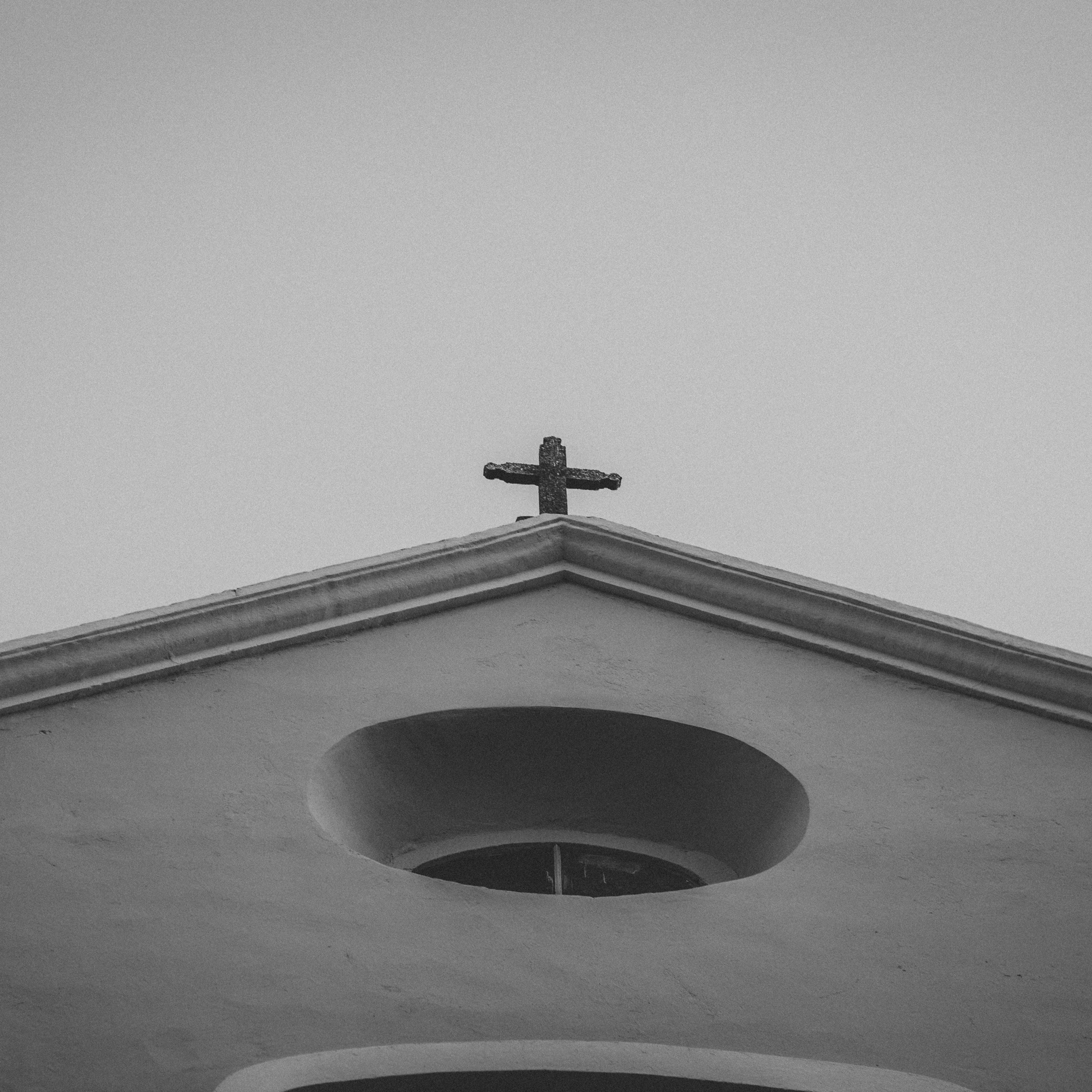
A Small, Permanent Damage
Toward the Condition of Myself

“Are you some kind of nihilist?” said the elder of P— Orthodox Presbyterian Church, seated directly in front of me, installed there. His eyes did not blink so much as reset.
“A nihilist?” I said, and the word did not belong to me.
“Nihilism holds that life has no inherent meaning or ultimate goal; in its moral form, it rejects the existence of objective ethical standards; in its epistemological form, it doubts the possibility of certain knowledge; and in its metaphysical form, it may deny the reality of stable structures such as causality or identity. Uh, I am saying that it seems you are against belief as a whole. You believe nothing.”
Whether I am or am not should not render solace. If God is truly absolute, He is not ratified by my assent nor diminished by my incapacity. Divine aseity does not fluctuate with the condition of my phenomenological state of mind. What unsettles me is not doubt in the vulgar sense but a structural disjunction: the grammar of transcendence remains intact while the subject who is meant to speak it defaults to cohere. I can articulate sovereignty, grace, judgment, mercy; yet articulation is not participation. The breach lies not in doctrine but in ontology. If faith is not an achievement but an effect, then its absence cannot be remedied by effort; it exposes a limit within the self that cannot be crossed by the self. I do not experience apostasy; I experience non-correspondence. God, if He is God, exceeds apprehension without thereby becoming simulacral. The brutality is this: transcendence remains inviolable while the creature becomes conscious of his own metaphysical insufficiency before it.
The overhead light was throbbing. I drew into myself with a sudden, reflexive tightening, and psychosis began to admit itself: Bodies strapped in supine suspension from the ceiling, arms drawn outward, ribs lifted and fixed, heads angled without expression. They did not signify anything. They were not martyrs, not warnings, not symbols. No voice explained them. No gesture redeemed them. The longer I looked, the less they meant. That was the difficulty: persistence without disclosure.
If there was a message, it was subtraction: whatever we call God is not found in rescue or spectacle but in the refusal to answer. The mind resists this and begins to supply reasons, begins to tremble at the stillness. But the bodies offer nothing. They hang, and in their hanging disclose only limit.
“You are aware that you will answer before God, thrice-holy, immutable, sovereign in power, for the absence of yourself and, worse, that of your daughter? What are you doing? You have forsaken the gathering of the saints.”
Elder R— spoke gently; that was the violence. His words were a fixed glare—lucid and pitiless—moving outward in cessation until all space collapsed.
“I just have thoughts often. Is any of this real or not? I question the existence of God, often.” I choked, and my face numbed into nothing.
You believe nothing.
I am aware that I carry a peculiar scent, or believe I do: yewheart and bleached linen, clotted honey, an undernote of black fire, banked and breathing, burning low in the tenebrous stroma of my human flesh.
So I exert a pull upon you?
Do you require my animating principle?
Do you need my attendance, my body partitioned within the looming white?
And what of my death?
What will you do with me?
Won’t I die soon?
I think I have made that opalescent in appearance.
And when I go cold,
when I am only weight and silence,
what will you make of me then?
Will you keep me, empty me, bury me, wear me?
What use am I to you once I cannot answer back: the scars, the bruising underneath the chin, the manic pacing into a vacuum, the lovely dark, the scorching eternal affection?
Oh, I have not had affection on this earth.
I want to be loved; that is what I want: to be loved, to have that love crawl up through the plantar fascia and into the calcaneus, threading the tibial canal, breaching the pelvic cavity, and climbing the inferior vena cava until it enters the right atrium and presses, insistently, against the heart. Is your intention to love me?
As the waitress approached with plates balanced along her forearm, she leaned forward—she seemed fractionally misaligned—more than the movement required. Her torso inclined at a severe angle, held there by decision. From the arc of her collar, her neck extended, lengthening until distance dissolved. She advanced without urgency, vertebra by vertebra, until her eyes found mine and fixed there and her lips met my lips. I drew her breath into my own, and the air between us became indivisible.
Her tongue came out of her mouth like a Giant Palouse earthworm, and the creature began to fester at the immediacy of my face, at its new entrance. It entered my mouth and burrowed into a coil at the back of my throat, causing me to gag. I retched as her tongue probed deeper into the esophagus. Her eyes gathered a resinous film and began to ooze, slightly sticky, adhering to my eyes. Without light. Hypoxic. My limbs began to spiral into my chest, and the margins of my vision dimmed, closing slowly into black.
The waitress walked away.
“You mistake boredom for intelligence,” he said. “You describe it as independence. It is not movement. It is decline.” He examined me with the impersonal attention of a surgeon evaluating a lesion.
If I did not return, if I did not submit myself, he assured me I would not be punished in spectacle but in permanence: sealed inside the small, proud chamber of my own mind, forever aware that I had been offered mercy and preferred myself instead. Then he shrugged, as though my damnation were an administrative detail, and reached for his water.
“And what of Augustine, Kierkegaard, and Athanasius? Were they not compelled into belief only after exhausting competing accounts of self?”
“They exhausted nothing,” he said. “They were exhausted. There is a difference. Augustine did not theorize himself into God; he collapsed into the insufficiency of himself. Kierkegaard did not survey competing accounts like a consumer. He found that the self, left autonomous, disintegrates. Athanasius was not sampling identities. He was confronting fracture, moral, metaphysical, historical, and concluding that the alternatives did not cohere.”
He leaned back. I tilted my eyes to the floor.
“If you persist in parading your infinitesimal self-ideologies about life, existence, and eternity, let this conversation stand as its own indictment, a record of your refusal, your studied resistance to submission before the God you reduce to abstraction. You treat ultimacy as a channel for speculation, as though it were proportionate to your private understanding. It is not. Should you continue in that posture, the consequence will not be theatrical but terminal: exile into outer darkness, a complete condition in which the self you have so carefully defended is left intact and unrelieved, cast among the amassed annihilation of countless others in a depth without horizon, without light, without reprieve; a permanence of burning consciousness in which rejection is no longer argument but environment, and the will that would not bow discovers too late that it cannot extinguish what it has chosen.”
“Cordial, aren’t you?” I said with some kind of new brokenness inside.
He paid—a signature of proof.
On the drive home, I thought of nothing. I have come to suspect that nothing is a more honest condition than grand eternities. You believe nothing. Perhaps. Or perhaps I have suffered and felt the incision of a will not my own, one that resents that I was willed at all.
I want love more than I want deliverance from hell. I want a singular will to choose more than I want the correct choice pressed from me with threats. I am okay with failure. I am willing to fail, willing to be wrong, so long as it leads me, in the end, back to myself. I want to know who I am.
I want to know myself.